| Thrive! Center - Beehouse, Barn & House |
|
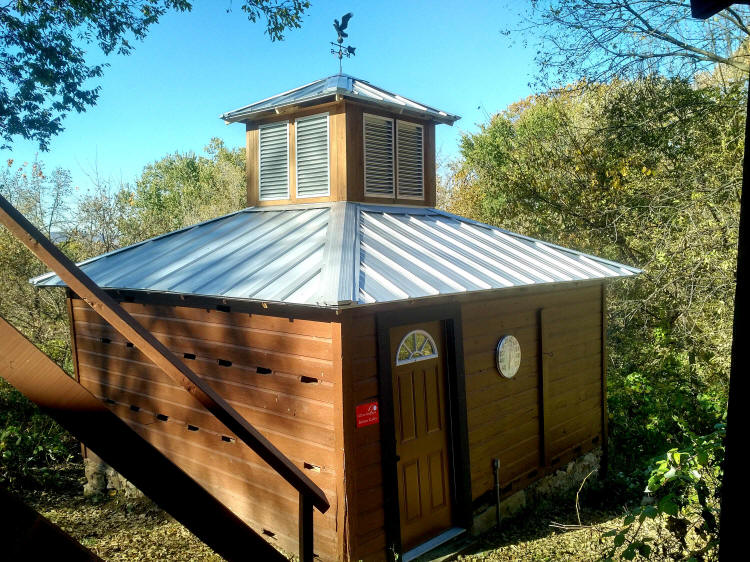
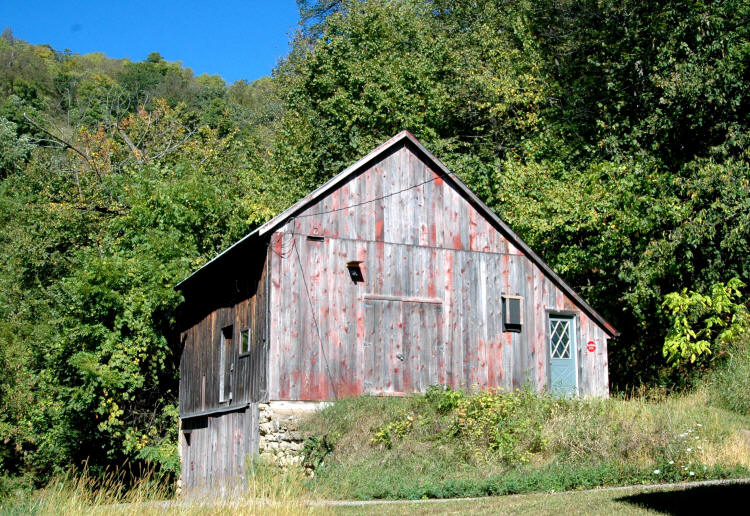
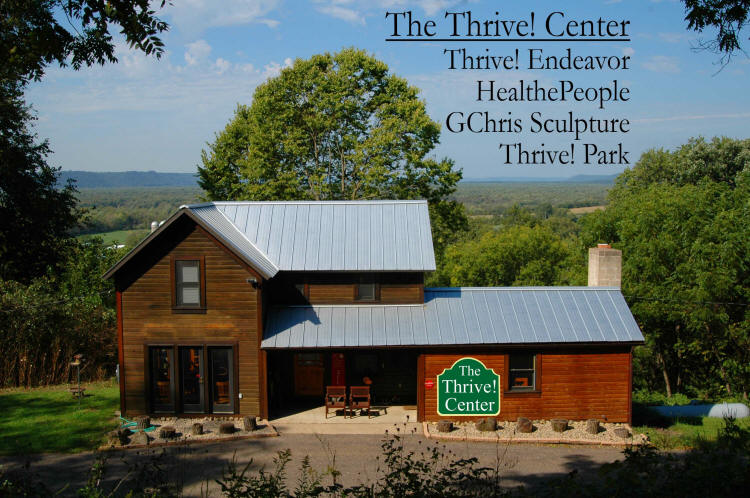
History The Zimmerman family were first people to settle on property in 1883. A circa 1900 photo of property from Pikes Peak blufftop shows all three buildings, an orchard above the house and fields to the south. There was also a blufftop field (sold 1972) that was serviced by steep bluff road, now referred to as Bluff Hiking Road. It is likely two-story barn was first building built, often the case with early farms. Also, barn construction is mostly hand hewn beams while house and beehouse are all sawed lumber. Barn is small basic barn that probably housed couple of horses and maybe couple of cows and other livestock. The Zimmerman family may or may not have lived in barn while house was being built. The southeast corner of upper barn was framed in and covered with lathe and plaster. They were beekeepers and probably made part of their livelihood from honeybees. Beehouse is unique and very large (16’ x 16’) with spaces for 27 hives. There was also a large cupola to help ventilate the heat in the summer. The beehouse had an internal chimney which was used to “smoke” the bees and make it easier to service them. The house is two-story frame house with a stone foundation. In the basement is a cistern for water and a root cellar.
Protecting The Historical Buildings Barn. The barn was one building Chris always planned to save. When he bought it, roof was weakened and the center of the roof sloped downward. Side of barn toward the bluff had caved in from pressure of the bluffside. Lower level had dirt floor and the woodchuck. Woodchuck had to be safely evicted. Upper-level floor and support system had to be replaced. When fully restored/renovated, barn had new roof bracing, new metal roof, partial replacement siding from similar age barn, new upper floor and floor joists, new concrete floor in lower level, and a new storage section on upper level. Beehouse. Beehouse is a unique story of a unique building. When property was purchased, center of the roof had caved in and floor and support system had caved in. No one knew it was a beehouse. All that was known is that it had 27 small openings for a purpose unknown. Initial approach was just to protect the building by putting on a new roof and floor system. Talking to many beekeepers, including European beekeepers, the story unfolded. Likely it was a Swiss type beehouse. Honeybees would have been brought to the U.S. from Europe. Honeybees are not native to the U.S. It housed 27 beehives and was more than twice the size of most European beehouses. The extra space was likely used to process honey and wax (for things like candles). None of U.S. bee people had ever seen such a beehouse in the U.S. According to the Wisconsin Historical Society, it is the only 1800s beehouse in Wisconsin and one of the few (if any) in the United States. House. First question was whether there was enough of the house to save. After a lot of interior demolition and removal of two layers of siding, Chris found original 135-year-old siding, covered since 1902. Most floors were restorable. The original two-foot-thick stone foundation was fairly sound. The rest? Not so good. Chris decided to rescue the house. What partially drove Chris’ decision on preserving buildings was that so many pre 1900 building were being lost. Along with the buildings, a substantial part of history was being lost. Chris believed there was substantial value in preserving key parts of history. In this case, history was a small bluffside farm built by a family over 100 years earlier. Renovation/restoration strategy for the house was to preserve as much as possible and have it continue to look like 1885 but with modern mechanicals (heating, air conditioning, electrical, plumbing), new drywall, refinished floors, new roof, and new doors and windows. All that took almost several years to get done. While he contracted for much of the renovation and restoration work, Chris traveled several times each year to do parts of demolition and renovation. It was essentially done by 2012 when Chris moved back from Washington (DC). |
|
Thrive! Center Beehouse
|
|
Thrive! Center Barn
Thrive! Center House
|
#Thrive #ThrivingFuture #ThriveEndeavor #AllThriveForever #T! #Thrive!
Thrive!
Park
Thrive! - All Thrive Forever